"Architecture and Culture: The Meaning of the Lowell Boarding House"1
by
Richard P. Horwitz
A version of this essay first appeared in American Quarterly, 25:1 (March, 1973), pp. 64-82.
* * *
Groucho: Well, here's the barn!
Chico: I don't know - maybe it's a stable, eh?
Groucho: If you look at it, it's a barn; if you smell it, it's a stable.
-The Marx Brothers, "Monkey Business"
* * *
In the 1820s, a small agricultural setttlement in eastern Massachusetts became "Spindle City." The corporation boarding house was an important aspect of that change. Whether defining a literary setting or surmising the operatives' health, residents almost invariably considered the boarding houses. They were an assumed factor, somehow central to the Lowell experience and, therefore, somehow central to our understanding of that experience. My purpose is to learn the meaning of those boarding houses in the early 19th century, their relationship to the Lowellite's world view.
Such a study presupposes some knowledge of the structures themselves, what they mean to us.2 Few early buildings or plans remain, but they are recreated in the photographs and drawings of Mill and Mansion.3 John Coolidge probably offers the most thorough and accurate description to date of Lowell architecture and its place in design evolution. Yet from its 20th century perspective the book may serve only as a point of departure in discovering the significance of the built environment for its contemporaries. The problem is, as Amos Rapoport puts it, "Whose meaning in architecture?": "I would suggest that we have generally tended to consider the meaning that it has for the architect or at least the cognoscenti, the critics, those in the know, and have also assumed that there is a single meaning, rather than a multiplicity of meanings. The question I would pose is the following-what meaning does the built environment have for the public, for its inhabitants and users?"4
In order to understand the historic meaning of the boarding houses, one must study the minds of the Lowellites themselves, their modes of perception, evaluation and response.5 Clearly their images of the built environment may be different from our own. Since significant differences in building images have been documented between groups within contemporary America, it seems highly probable that profound image differences exist between contemporary and 19th century Americans.6 The central methodological problem, then, is to translate images of related stimuli, the boarding houses as perceived by early Lowellites, and those remaining, physically or in Coolidge's writing, as we perceive them today. By matching the structure with its image, we can understand the historic meaning of the boarding house.7
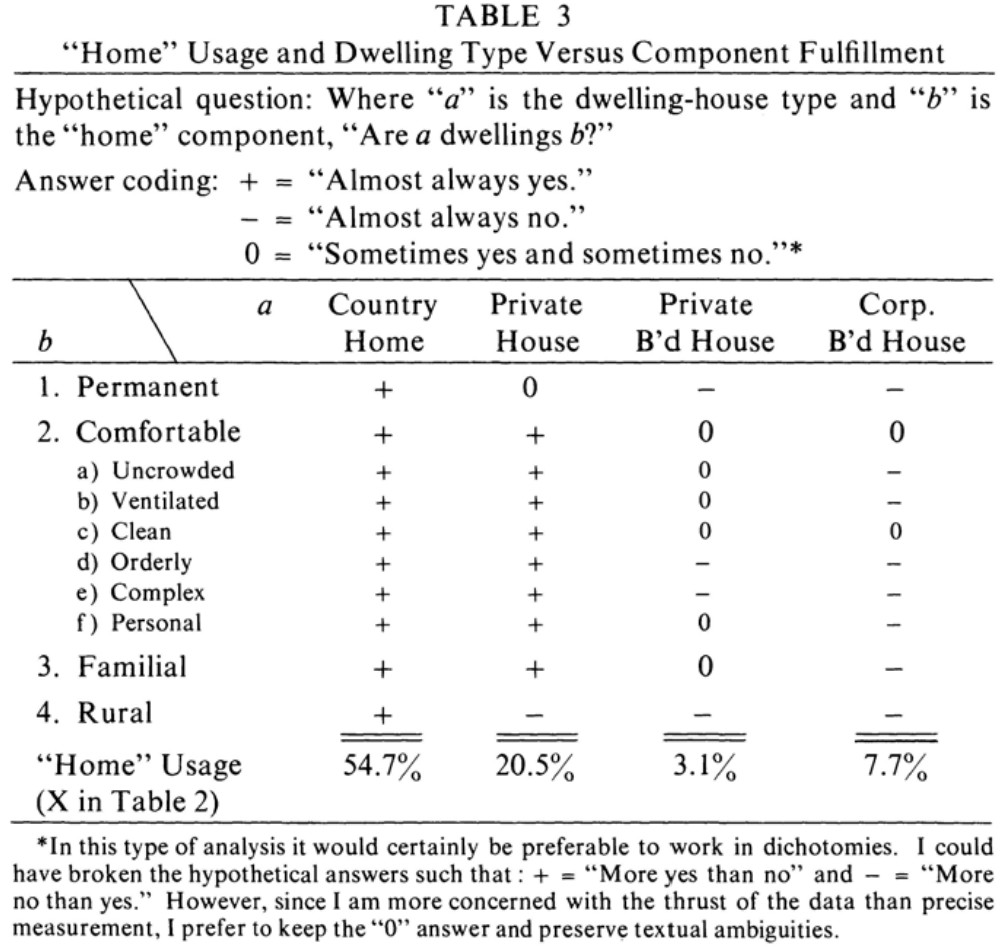
The ideal solution to the methodological problem would probably be survey research. Through a series of pretested questions and situational controls an investigator can construct a detailed image of his subjects' perceptions. Such studies have already been conducted upon modern populations, yielding thorough descriptions of "the common man's" concept of high-rise apartments, low-cost housing and other contemporary versions of the Lowell boarding house system.8 Unfortunately this approach must remain only an ideal in this study, for the documents the 19th century "common man" left us are neither answers to pretested questions nor products of controlled situations. With a sufficient understanding of the historical beliefs associated with the boarding houses, however, one might be able to "predict" the results of survey research, how people would have explained the boarding house's meaning (see Table 3, р. 78).
The data problems, particularly those of limits, for such a study are immense. What communications are relevant to examining the belief system of Lowellites? Since primary interest here is the period of founding and growth, somewhat arbitrarily defined as the 1820s to 1860s, data are limited to those documents written by Lowell residents within that period. Due to the scarcity of such information I am forced to consider also some documents dated slightly later. There is, of course, great danger in treating remembrances of the far and near past together. However, as I trust will become clear later, in this area of belief elemental perceptions (those shared by individuals and subgroups) were quite stable throughout the period.
Because no systematic process operating in survival is apparent, I think we can assume, with reservations, that the surviving papers are a reasonably random selection of those written for circulation. The differences in document types necessitate these reservations. Newspaper collections, for example, are significantly more complete than personal reminiscences, assumedly due to their more obvious value to traditional history. This stratification in source material is even more significant in view of the relationship between form and the author's thought. Obviously a private diary would tend to reveal more deeply its author's perceptions than an "objective" newspaper for mass consumption. Similarly a mill girl writing a story for corporation-sponsored publication or writing a pamphlet to amass pressure for corporate reform would present systematically different images of the boarding house system. As Benjamin Colby points out, simply pooling text types does not necessarily solve the problem, for each one may be a "unique part in a mosaic rather than a replicated element."9 If one is asking, "Did the authors usually say the boarding house life was good or bad?" surely the pooling technique is inadequate. The oversimplification inherent in such a question has plagued content analysis, frequently reducing it to a pseudoscientific counting process. A visitor's guide, for instance, suggests that the boarding houses are clean and in good order, while a mill girl recalls her house was "clean and in repair"; do these add up to two votes for "clean and orderly" or would that constitute summing the proverbial apples and oranges?10 For the count to have any significance the units must be the same and, if those units are feelings, they are not even crudely similar unless the context is the same.11
An alternate technique, therefore, must operate on a "replicated element" that transcends textual forms and consequently the "pooling problem." For the Lowell boarding houses, the best focus seems to be the terminology itself. We may hypothesize that what we perceive as the boarding houses and their "system" were new, important stimuli in the Lowellites' environment, new elements in their reality which had to be given new names, subsumed under old names or ignored. Presumably, to successfully communicate with his audience, an author had to use an accepted terminology, regardless of the textual form. One could not, for example, successfully locate someone inside a corporation boarding house without some sort of communicable symbol designating that location. Before describing the nature of Lowellites' perceptions of the boarding houses, then, we must determine that they perceived them at all and, if they were perceived, in what cognitive categories they were symbolically classified.
In constructing a folk taxonomy I assumed that the boarding houses belong to some part of their "built environment," a cover term for all man-made enclosures (see Table 1). Ideally one should derive the cover term from a taxonomy of their entire world view, but within the limits of time and space this was impossible. My original assumption, their perception of a built environment, unfortunately was not substantiated; that is, I could find no verbal symbol which consistently subsumed "public buildings," "churches," "establishments" and "dwelling houses." When they were discussed together the author simply listed them.12 Furthermore, the former three categories were cognitively constrained almost to the exclusion of the latter. "Building" and "structure," for example, were often used as synonyms for "public buildings," "churches" or "establishments" but only very rarely for "dwelling houses." Dwelling houses, in other words, composed a unique category of the built environment, definitively bounded by its own terminology.13
Despite the artificiality of the cover term, it offers some important conclusions for this study. First, any general discussion of the meaning of "architecture in Lowell" is dangerous. Lowellites apparently had quite different terminologies for what they saw as very different kinds of enclosures. Any of them could have been said to be "clean" or "flat-roofed," but the significance of such descriptions should be gauged by the category to which the structure belonged. Lowellites clearly had different expectations for different categories of the built environment. Second, excluding the dwelling houses all the categories and subcategories were differentiated almost purely on functional grounds; that is, the name given to a building relied essentially upon what people did inside it.
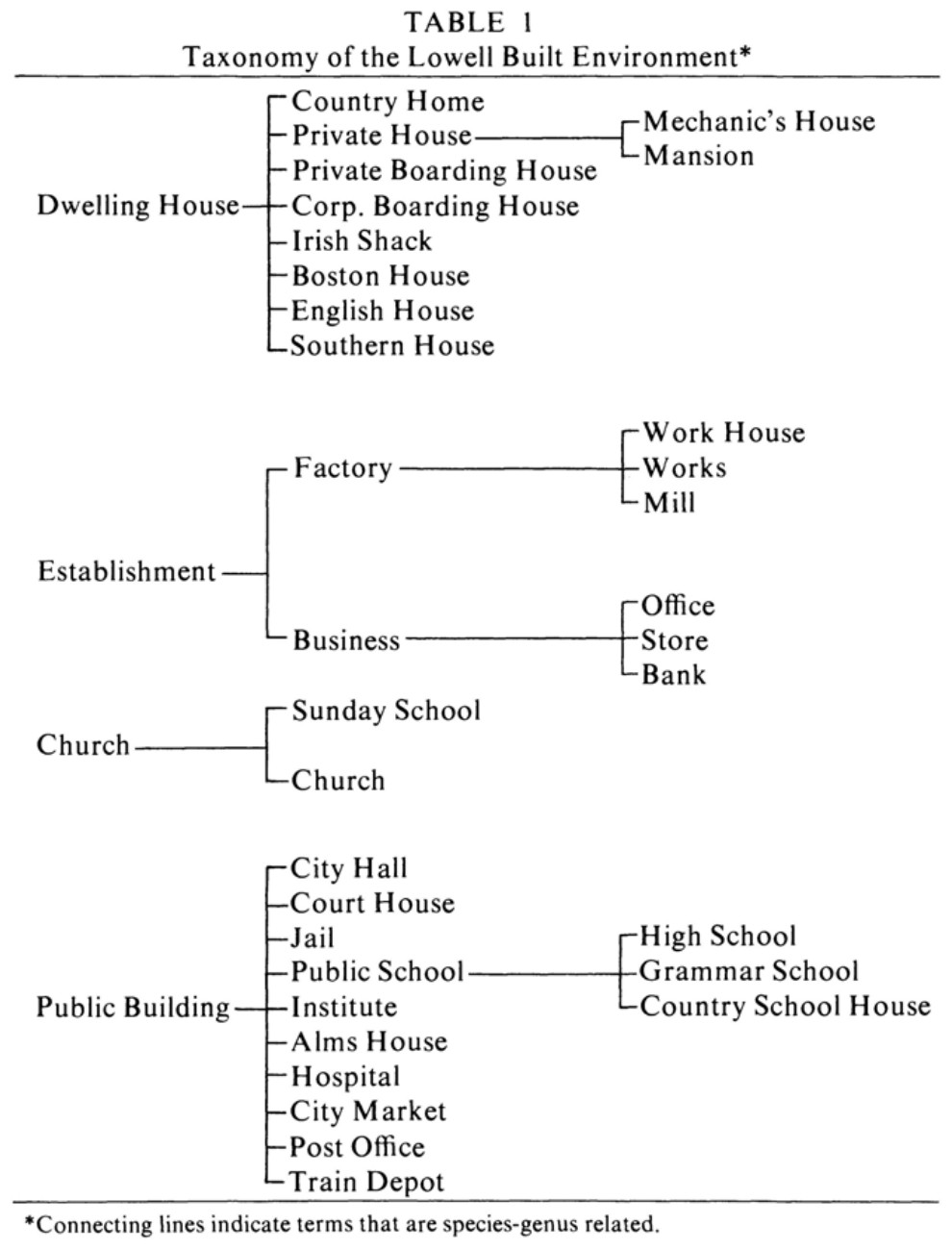
Hypothetically, for instance, if one were to stop production in a mill, put in some beds, sick people and a doctor, it would have "become" a hospital.14 This observation indicates the organic relationship between the community's built environment and its way of life and, hence, the reservations one should have about any "inherent" meaning in a design. Appleton Row to most Lowellites was not a "compromise between architectural approaches" but a block of boarding houses.15 Therefore, a discussion of the meaning of the row should describe architectural approaches in the terms of boarding houses rather than boarding houses in the terms of architectural approaches. Third, as might have seemed initially obvious, the corporation-owned boarding house composed a subcategory of the people's world view. They were part of the Lowellites' perceptual reality, something they could talk about, and consequently a proper unit for the analysis of culture and meaning across individuals, subgroups and text types.16 Fourth, and probably most important, corporation boarding houses were a type of dwelling house and therefore should be examined within that typology. A discussion of perceived similarities and differences among dwelling house types is not an inane, ethnocentric concern, but one central to understanding the symbolic organization of the Lowellite's world view. The meaning of the factory boarding house is revealed in its perceived relationship with other dwelling house types.
To understand their relative meaning, however, one must again beware of simply pooling superficial text statements. For example, the Reverend Mr. Miles' assertion that the boarding houses, "are finished off in a style much above the common farm house," can hardly be treated as a response to a standardized question in a controlled situation.17 On the contrary, such a remark could be the unique result of a peculiar set of circumstances. Because we cannot be reasonably sure what prompted him to make such a statement, we cannot safely generalize about how Miles "really" or "usually" perceived the boarding houses. Without this information there is not even sufficient grounds to pool this particular thought with others.
In the search for a truly "replicated element," terminology again offers an alternative. In choosing what to call the factory boarding houses Lowell authors had to select recognizable symbols from the dwelling house terminology; they had to choose words which carried a specific meaning for their readers. They used "factory boarding house" or "corporation boarding house," indicating minimally a dwelling house that is corporation owned and supervised, but they also used such approximate synonyms as "abode," "house," "residence" and "home." Certain of the synonyms were applicable across dwelling house subcategories; specifically, "house" or "home" could refer to a corporation boarding house, private boarding house, private house or country home depending upon the context. Synonyms, however, do not have precisely the same meanings. There are differences, ranging from slight to dramatic, between symbols referring to the same object.18 To give an obvious example, the same dog might be described as a "cross-breed," "mongrel" or "mutt," a group of synonyms with quite broad-ranging connotations. The degree to which the dog's master might consistently choose one of these three terms, I think, reveals much of the man's perception of his pet or, phrased differently, the pet's meaning to his master.
The same sort of reasoning can be applied to deriving the meaning of the boarding houses: Did the "synonyms" carry different connotations? Were these synonyms used randomly or systematically across dwelling house types? Naturally, the first of these questions was of some concern to the Lowellites. Whether they perceived the corporation boarding houses as generally good or bad, some language consensus had to be reached to allow communication. In this respect the distinctions in usage between "house" and "home" are significant. At one point they are used as synonyms for non-corporation boarding, corporation boarding, private and country houses. Nevertheless, writers used them discriminately. The distribution of dwelling house terms within 24 diverse documents makes this quite clear (see Table 2). Although the total number of mentions is disappointingly small, particularly for the private boarding houses, the figures are indeed startling.

Most interesting is the use of the word "home." While it symbolizes a corporation boarding house less than 8 per cent of the time, it symbolizes a country home some 55 per cent of the time. Despite the vast differences in personalities and text types, Lowellites seem to have agreed that country homes were "home"-like and that corporation boarding houses were not, that the attributes of "home" were missing from the system. This difference in usage almost always transcended authors' overt differences over the quality of mill housing. While Miles describes the factory boarding houses as Lowell's glory, for example, Bartlett's critic sees them as its downfall. The distribution in usage of "house" and "home," however, is approximately the same in both their writings.19
The differences in distributions are apparently due to a systematic variance that the Lowellites perceived between the meaning of the words and the meaning of the dwellings, their semantic fit. There are, of course, conventions in usage that are somewhat peripheral to word meanings. In the documents, for example, "to go home" is used as an idiom roughly meaning "to return." The word "home" within the idiom seems to carry significantly less discrete meaning than it does in other contexts. I do not think, however, that this idiosyncrasy detracts from the proportions' significance. Despite its generally broad usage "going home" is used almost exclusively to mean "returning to one's country home" when lengthy trips are involved. Although mill girls might "go home" from the mill to their boarding house or "go home" from their Lowell to their country house, they were not said to "go home" from outside Lowell to the boarding houses.20 In some respects, then, the disparity between "home" and the meaning of the corporation boarding house even shaped the use of an otherwise general idiom. A similar problem is the standard usage of "house" when discussing the size of any dwelling in dimensions or the number of stories. If such contexts arose significantly more often for corporation boarding houses than country houses, then the differential in "house" to "home" usage would lie more in usage convention than semantics. This does not, however, seem to be the case. Though certainly more frequent for boarding houses than country homes, such precise descriptions of size are exceedingly rare-and could not, I think, account for the dramatic spread in the distributions. We must then turn to the semantic components of "home" that made it so often applicable to a house in the country but so rarely to a corporation boarding house in Lowell. These components reveal not only much of the meaning of the houses but also the significance they had for the authors' world views, why, as one apparently more candid author said, the mill girl's Lowell was "a home for the homeless."21
The most central component of "home" made it appropriate for all the dwelling-house types. It minimally required "a place of abode."22 The differences in usage distributions across types suggest that other, more subtle qualities determined the word's application. One very important quality was permanence. "Home" symbolized a place in which a person lived for a long time, "a place of constant residence."23 The "old" cottages, as they were so frequently described, certainly satisfied this criteria more than the corporation boarding houses. Many of the authors boasted about the residents' transience: "After an absence of a few years, having laid by a few hundred dollars, they depart for their homes, settle down in life, and become the heads of families."24 Usually described as an asset, the temporary nature of the Lowell experience indicated that the boarding house could not be a "home."
Probably the most differentiated component of "home" was comfort. By spending sufficient money or time on a house to make it comfortable, one could presumably make it a "home": "The statements of Doctor Bartlett in relation to the price of board refer only to the furnishing of meat and drinks, and an individual sixth or tenth of a lodging room, in which to rest the weary limbs. But this is not all that is necessary. The price of board should be sufficient to make the boarding-house a home and furnish it with the comforts of life that all have a right to enjoy."25 Despite the historical arguments over the quality of rural life, country houses were almost universally described in warm terms. "The comfort of home" is a phrase which the authors repeated incessantly, always seeming to assume that the "home" type of comfort was quite special and good. A mill girl could dream of "the lounges and easy chairs and ottomans my busy fingers would manufacture for real home comfort."26 The comfort of the boarding houses, of course, was a subject of frequent debate. Interestingly, however, although Lowellites romantically recalled the "real home comfort" in the country, they never applied this phrase to the boarding houses.27 Carpets, furniture and an occasional piano were not perceived as "the comforts of home."
Freedom from crowding, the opportunity a resident might have to be alone, was valued as a subcomponent of comfort. This was undoubtedly a characteristic of the "lonely" or, from another perspective, "desolate" farmhouse. The boarding houses presented a startling contrast to the Yankee farm girl: "She went into her own room . . . . She thought how hard it would be to have no place to which she could retire and be alone."28
Associated with relative crowding in one's environment was the quality of ventilation. A "home" had fresh, clean air to breath, a guarantee for good health. On this parameter, too, the boarding house was inferior to any rural abode. One Lowell writer described the mill girls in their sleep, with such crowded sleeping quarters, "Inhaling and rehaling the same air thereby made poisonous and deleterious to health."29
Cleanliness was a similarly hygienic subcomponent of "home." The girls and their associates repeatedly describe the impeccably clean country homes of their childhood. They seem to have felt that the boarding houses also were kept clean and in good repair until the latter part of the 1825 to 1860 period.30
Comfort also implied a measure of order in the life style associated with the house. An excerpt from Charlotte Hilbourne's Effie and I demonstrates the constraint of order within the meaning of "home": "I was pleased with her home-with the neatness, regularity, and promptness with which everything was accomplished in their due season."31 Typically, the home that here was so pleasing was an old rural cottage. The boarding houses again presented a contrast to the Yankee farm girl. She and other Lowellites might be led to consider, "How difficult it would be to keep things in order in the fourth part of a small apartment," or to complain about "the endless bustle and noise and gabble."32
Visual complexity may have been a fifth subcomponent of comfort, but the documents grant this division only weak support. Lowellites were only vaguely concerned with the attractiveness of structures. The rigid symmetry of the factory housing, however, disturbed some of the citizens, apparently because such an appearance was incongruous with their rich images of "home." They objected to "the uniform appearance" of the 19th century housing project.33
A similarly tentative subcomponent would be the amount of personalized space available to the individual. How much of the structure could a person call her own or change freely if she wished? Presumably, the more personalized a house, the more it became a "home." Possibly it was this aspect of comfort that led one mill girl to mourn the shortage of closets and shelves while acclaiming the single peg each girl had for her bonnet in the doorway.34 Some certainly perceived a difference between what they cynically called "my fourth, sixth, or tenth" of a boarding-house room and what they fondly remembered as "my room" in "my home" in the country.
In addition to permanence and comfort, the third major component of "home" was the presence of primary kinsmen; "homes" had a mother or a father. Since most of the mill girls left their families in the country, one would expect them to think they had also left their "homes" or, as they put it, their "parental," "paternal" or "childhood homes," "the old paternal homestead."35 An "Extract from a Journal" in The New England Offering vividly exemplifies the dilemma this component presents to Lowell's new arrivals. In a letter to her mother one begins facetiously, "In a new home, I should not quite forget the new 'mother.' Mother! She is not you; yet she seems anxious that every member of her large family should forget this is not her home."36 An equally dramatic presentation of the role of kinsmen in the meaning of "home" appears in Loom and Spindle. Harriet Robinson changes her usage of the word "home" as the domestic role of her family changes in the text. While her mother is keeping boarders in the autobiographical narrative, usage of "boarding house" and "house" predominates. After 1840, however, when her mother stops taking boarders, making it a family dwelling, usage of "home" predominates.37 The role of family, then, was an important part of the meaning of "home."
Finally, "home" was in a pretty place, usually in the country. The repeated romantic, pastoral imagery in the writings indicate most Lowellites' preference for "pleasant country homes." Urban phobia permeates many of the documents and certainly affected Lowellites' perceptions the boarding houses. As an extreme example, the author of Corporations and Operatives declares, "It would be a gross insult to the farmers of the country, their fathers, to tell them that their homes were such that their daughters would improve more by being subjected to the influences that surround a factory population than at home."38 The dichotomy he employs is particularly interesting: One is either "under the urban influence" or "at home,"implying the country is part of "home."
In sum, I propose that these four major components, permanence, comfort, kinsmen presence and country setting, were in varying degrees associated with the word "home." The more Lowellites perceived a dwelling type as fulfilling these criteria, the closer the meaning of the dwelling type fit the word "home" and, consequently, the more often the word was a suitable symbol for that type. These components were parameters of meaning and usage of the word "home"; the degree to which people applied the term to a dwelling type indicates how permanent, comfortable, familial and rural it was perceived as being. Ideally, then, one could scale the perceived, relative fulfillment of these categories across dwelling types, and this scaling would correlate with the proportional usage of "home" (see Table 3). Although the data is too small to merit rigorous statistical analysis, the relationship between component fulfillment and "home" usage is at least in the predicted direction. With a larger data set one could presumably measure the relative importance of each component as a factor in "home" usage. Short of such analysis, however, it seems clear that: first, most often Lowellites did not perceive the factory boarding houses as "homes"; second, they in varying degrees perceived "home" as permanent, comfortable, familial and rural; and consequently third, they perceived the boarding houses as in some measure lacking these attributes. That Lowellites so often used "home" as a standard against which to evaluate the boarding houses accentuates the importance of these conclusions.
Whether the authors noted a favorable or unfavorable comparison, they assumed "home" was an acceptable standard. Indeed, it seems to have been the measure of the boarding house's real or potential quality. Re-examine, for instance, Robinson's declaration: "The atmosphere of the boarding houses was as refined as that of their own homes." Such a remark takes for granted a "refined atmosphere" at "home" and compliments the boarding houses for successful imitation. Similar comparisons occur throughout the early writings. Lowellites were apparently trying to deal with a new element in their environment, the corporation boarding house, by translating it into familiar terms, its likeness to "home." The salience of this comparison seems to have structured their perceptions of the boarding houses and, hence, the houses' meaning. The components of "home" in this way provided a construct in which to form and evaluate perceptions. In many cases the effort to fit the boarding house against the "home" image is particularly clear; for example, recall Bartlett's critic's insistence that comforts "should be sufficient to make a boarding house a home." At other times the language of "home" seems forced upon the boarding houses, yielding relatively inappropriate substitutions. A few selected illustrations across the various components and subcomponents of "home" make this comparative process clear: in comfort, "Nowhere can a better substitute for those wants which nothing but a home can supply, be found than are found here"; in cleanliness, "An air of neatness and comfort exceeding what most of the occupants have been accustomed to in their paternal home"; in order, "The privileges and wholesome restrictions of home"; in kinsmen presence, "Crowded together in one family from thirty to forty persons being entire strangers"; and in country setting, "In the midst of the dizzy rush of machinery they can hear in fancy the ripple of brooks, the low of cattle, the familiar sounds of the voice of home."39
Early Lowellites' image of "home," then, mediated their perceptions of the factory boarding house, just as it mediates our understanding of those perceptions. Measured by the authors' choice of the word "home," the boarding house did not meet their standards, and despite the vehement disagreements over the boarding house's quality, most could agree it did not really mean "home"; it lacked many or all of the attributes which would make it so. In this respect it was inadequate. This is not, of course, to conclude that Lowellites thought the boarding houses were "bad," only that they were a poor imitation of the rural cottages the mill girls recalled. That some authors boasted about the boarding house's "family" and "comfort" while failing to apply the word "home" casts doubt upon their sincerity. If Lowellites thought these houses were "good," they would have to have recognized new criteria, new dwelling values drawn from outside the old image of "home," such as style, convenience, economy or efficiency. Whether good or bad, the meaning of the factory boarding houses must have been quite unsettling. When Miles casually remarked, "Only a very few of our operatives have their homes in this city," he did not mean that they lived in Chelmsford, but that during their stay in Lowell the mill girl's only home was in her memory.40 She had left her family, the beauty, comforts and permanence of home for Lowell. This was the meaning of the factory boarding houses. "Alas! for the home wanderer it would never be home again."41
Notes
I would like to thank Patrick M. Malone of Brown University and John L. Caughey, Ann K. Levy and Anthony F. C. Wallace of the University of Pennsylvania for their assistance in the preparation of this paper. I am also indebted to the Lowell Historical Society and Lowell Technological Institute Library.
This is an ethical as well as epistemological premise. "In the sense in which a man can ever be said to be at home in the world, he is at home not through dominating, or explaining, or appreciating, but through caring and being cared for . . . . To care for another person, I must be able to understand him and his world as if I were inside it. I must be able to see, as it were, with his eyes what his world is like to him and how he sees himself. Instead of merely looking at him in a detached way from outside, as if he were a specimen, I must be able to be with him in his world, 'going' into his world in order to sense from 'inside' what life is like for him, what he is striving to be, and what he requires to grow. But only because I understand and respond to my own needs to grow can I understand his striving to grow; I can understand in another only what I can understand in myself." Milton Mayeroff, On Caring (New York: Harper and Row, 1971), pp. 2, 41-42.
John Coolidge, Mill and Mansion, A Study of Architecture and Society in Lowell, Mass. 1820-1865 (New York: Columbia Univ. Press, 1942).
"Whose Meaning in Architecture?" Interbuild/Arena, 14/83 (Oct. 1969), 44. See also Amos Rapoport, House Form and Culture (Englewood Cliffs, N.J.: Prentice-Hall, 1969).
In the terminology of Kenneth L. Pike, I am expounding the "emic" approach and criticizing Coolidge for his more "etic" approach in Mill and Mansion. The distinction, now famous in anthropological literature, is that the "emic" approach "is an attempt to discover and to describe the pattern of the particular language or culture in reference to the way in which the various elements of that culture are related to each other in the functioning of the particular pattern, rather than an attempt to describe them in reference to a generalized classification derived in advance of the study of that particular culture." Language in Relation to a Unified Theory of the Structure of Human Behavior (Glendale, Calif.: Summer Institute of Linguistics, 1954), I, 8. For a fuller explanation of the emic-etic distinction see Pike, "Etic and Emic Standpoints for the Description of Behavior," in Alfred G. Smith, ed., Communication and Culture: Readings in the Codes of Human Interaction (New York: Holt, Rinehart, & Winston, 1966), pp. 152-63; and Ward H. Goodenough, Description and Comparison in Cultural Anthropology (Chicago: Aldine, 1970), particularly chap. 4.
The problem of perspective in architecture is of growing concern. See, for example Rapoport, "Whose Meaning in Architecture?", pp. 44-46; William Michelson, "Most People Don't Want What Architects Want," Trans-action, 5 (July/Aug. 1968), 37-43; and Lee Rainwater, "Fear and the House as Haven in the Lower Class," Journal of the American Institute of Planners, 32 (Jan. 1966), 23-31.
Michelson, Rapoport and Rainwater, ibid. This study's approach is derived from work in what is termed "semantic analysis," "ethnosemantics," "ethnoscience," "cognitive anthropology," or more broadly, "the analysis of world view." See Benjamin N. Colby, "Ethnographic Semantics: A Preliminary Survey," Current Anthropology, 7 (1966), 13-17; William C. Sturtevant, "Studies in Ethnoscience," American Anthropologist, 66 (1964), 99- 131. Excellent overviews include: Dell H. Hymes, ed., Language in Culture and Society (New York: Harper & Row, 1964); Ward H. Goodenough, "Culture, Language, and Society," A McCaleb Module in Anthropology from the Series Addison-Wesley Modular Publications, Vol. 2, Module No. 7 (1971); James P. Spradley, ed., Culture and Cognition: Rules, Maps, and Plans (San Francisco: Chandler, 1972); and Stephen A. Tyler, ed., Cognitive Anthropology (New York: Holt, Rinehart, & Winston, 1969). "The behavior is a response to an image, not a response to a stimulus, and without the concept of an image the behavior cannot possibly be understood." Kenneth E. Boulding, The Image (Ann Arbor: Univ. of Michigan Press, 1961), p. 43. For an introduction to the emic approach to space in anthropology, see Michael O. Watson, "Symbolic and Expressive Uses of Space: An Introduction to Proxemic Behavior," A McCaleb Module in Anthropology from the Series Addison-Wesley Modular Publications, Vol. 4, Module No. 20 (1972). A cogent opposing view to the cognitive perspective appears in Jacques Maquet, "Introduction to Aesthetic Anthropology," A McCaleb Module in Anthropology from the Series Addison-Wesley Modular Publications, Vol. 1, Module No. 4 (1971).
Rapoport, Rainwater, and particularly Michelson, which is drawn from data collected by John B. Lansing of the Survey Research Center of the University of Michigan. He and his associates asked 748 men and women what they had experienced in choosing a place to live.
"The Analysis of Culture Content and the Patterning of Narrative Concern in Texts," American Anthropologist, 68 (Apr. 1966), 374-88. Coolidge apparently also makes this mistake. In his chapter "Life of the Operatives" he describes a comfortable life for the girls, citing only three sources: John Swinton, A Model Factory in a Model City; H. A. Miles, Lowell As it Was and As it Is; and H. J. H. Robinson, Loom and Spindle or Life Among the Early Mill Girls. Coolidge, pp. 134 and 134n. In so doing he not only ignores the authors personal biases but also the possibility (probability, I think) of a propagandizing form of literature that would purposely distort the description of conditions.
Handbook for the Visiter to Lowell (Lowell: D. Bixby, 1848), p. 31. Harriet J. Robinson, Loom and Spindle (Boston: Crowell, 1898), p. 209.
"Klaus H. Krippenddorf, "An Examination of Content Analysis; A Proposal for a General Framework and an Information Calculus for Message Analytic Situations," Diss. Univ. of Illinois, 1959, p. 69. He says, for example, "Content analysis must be liberated from the concept of intersubjectively verifiable content in order for its results to be relevant for a theory of communication."
See, for example, Handbook for the Visiter to Lowell, pp. 30-35.
The folk taxonomy and other general conclusions about Lowellites' perception systems are drawn from a critical reading of the primary sources listed in the Appendix. Text types include reminiscences, guidebooks, maps, pictures, dictionaries, newspapers, novels, short stories and poems.
A similar, though not quite as dramatic change occurs in Robinson, Loom and Spindle, in which her "house" becomes a "home" by a simple change of its inhabitants and economics.
In noting the appearance of compromise between "normal late baroque" and "normal nineteenth century" approaches in Lowell housing architecture, Coolidge concludes that, "a tension arises just because Boot was conscious of the conflicting possibilities of both styles." Coolidge's evidence is limited to the buildings themselves and, I believe, is consequently rooted in his own, not Boot's "consciousness." Though an important critical observation, the "compromise" seems irrelevant to the "common man's" meaning in his housing in early 19th century Lowell. Coolidge, Mill and Mansion, p 38. Coolidge is somewhat aware of this perspective problem, but often lapses into ethnocentrism. For example: "Yet in private building it was quite customary to string houses together and we must not impute to the early nineteenth century our own standards of ventilation." He thus notes a difference in perspective, but even here his purpose is not to understand what the building was like to the Lowellites. He uses this perspective distinction to discriminate "true" or "accurate" (20th century) from "false" (19th century) descriptions. Coolidge, p. 184.
Boulding, The Image, p. 45. "The study of man is the study of talk. Human society is an edifice spun out of the tenuous webs of conversation."
The Rev. Henry A. Miles, Lowell As It Was and As It Is (Lowell: Powers & Bagley and N. L. Dayton, 1845), p. 67.
Colby, "The Analysis of Culture Content"; Charles E. Osgood, "Studies on the Generality of Affective Meaning Systems," American Psychologist, 17 (Jan. 1962), 10-29; John B. Carroll and Joseph B. Casagrande, "The Function of Language Classifications in Behavior," in Smith, ed., Communication and Culture, pp. 489-504; Ward H. Goodenough, "Componential Analysis and the Study of Meaning," Language, 32 (1956), pp. 195-216.
See, for example, Miles and Corporations and Operatives: Being an Exposition of the Condition of Factory Operatives and a Review of the "Vindication" by Elisha Bartlett By A Citizen of Lowell (Lowell: Samuel J. Varney, Printer, 1843). The usage ratio of "house" to "home" in reference to boarding houses in Miles is 43 to 1 and in Corporations and Operatives is 17 to 3. Including "boarding house" in the uses of "house," the ratios become even more impressive, 98 to 1 and 64 to 3, respectively. The usage ratio of "house" to "home" in reference to country homes in Miles is 0 to 44 and in Corporations and Operatives is 2 to 14.
Miles, pp. 114-15 and 135-39. Referring to girls who left the mill, the overseers say they "went home," assuming that the reader will recognize this to mean "their country home."
Charlotte S. Hilbourne, Effie and I; or Seven Years in a Cotton Mill (Cambridge: Allen & Farnham, 1863), p. 6. Hilbourne vividly depicts her two main characters' first and changing impressions of boarding-house life. See particularly chap. 6 and p. 78.
N. Bailey, An Universal Etymological English Dictionary (Edinburgh: Adam Neill, 1800). This dictionary is part of the rare book collection of the L.T.I. Library. Five different names are inscribed inside the front and back covers, presumably of its five owners. The top name on the first page is accompanied by the inscription, "Hanover, N.H." The dictionary, then, was probably brought to Lowell and kept as a reference text sometime in the early 19th century.
Noah Webster, An American Dictionary of the English Language (New York: Harper, 1848).
Mass. House Document No. 50, 1845; from, L. S. Bryant and J. B. Rae, eds., "Reports of Committees," Lowell: An Early American Industrial Community (Cambridge: M.I.T. Press, 1950), p. 260. See also Handbook for the Visiter to Lowell, p. 32.
Corporations and Operatives, p. 35.
Hilbourne, p. 178.
Ibid.
F. G. A., "Susan Miller," Mind Amongst the Spindles: A Miscellany, Wholly Composed By the Factory Girls (Boston: Jordan, Swift& Wiley, 1845), р. 89.
Corporations and Operatives, p. 10. Compare this image with, "The pure, invigorating air of the healthful country." Hilbourne, pp. 60- 61.
Robinson, pp. iv-v, 209.
Hilbourne, p. 65.
F. G. A., "Susan Miller," p. 89. Corporations and Operatives, p. 9. See also Hilbourne, pp. 44-48 and 64. Note that "apartment" in the early 19th century was used to mean simply "room in a dwelling." Here, as in most cases, it means "sleeping room."
See, for example: Lucy Larcom, "Among Lowell Mill-Girls: A Reminiscence," Atlantic Monthly, 48 (Nov. 1881), 598. Larcom writes of her arrival at a Lowell boarding house: "The romance of our journey came to an abrupt termination before a green door in a red brick block with green window-blinds, the third in a row of four brick blocks, each the exact counterpart of the other."
"Duties and Rights of Mill Girls," New England Offering, 2 (May 1849), 100-1. See also "Extracts From a Journal," New England Offering, 2 (Apr. 1849), 93: "These unhappy folks [her boarding house roommates] must have a place in the world, but I wish it might be where they could be monarchs of all they surveyed, and where there could be none their rights to dispute.
Miles, p. 68; Hilbourne, pp. 41-43; John G. Whittier, Stranger in Lowell (Boston: Waite, Pierce, 1845), р. 22.
"Extracts From A Journal," New England Offering, 2 (Apr. 1849), 93. This series is particularly interesting for personal impressions. See also 2 (Apr., Aug., Nov. 1849), 92-93, 181-82, 263-66.
The usage change, however, is only slight, presumably because of the exceptional nature of her boarding-house experience. Harriet Robinson lived with her mother in a particularly comfortable boarding house for an unusually long time - precisely the conditions I predict would increase the use of "home." See Robinson.
Corporations and Operatives, p. 19.
Elisha Bartlett, M.D., Vindication of the Character and Condition of the Females Employed in the Lowell Mills, Against the Charges Contained in The Boston Times, and The Boston Quarterly Review (Lowell: Leonard Huntress, 1841), p. 14; Miles, p. 68; Larcom, p. 595; Corporations and Operatives, p. 8; Whittier, p. 22.
Miles, p. 129.
Hilbourne, p. 48.
Appendix
*Appleton, Nathan. Introduction of the Power Loom and Origin of Lowell. Lowell: B. H. Penhallow, 1858.
Ayer, J. C., M.D. Some of the Usages and Abuses in the Management of Our Manufacturing Corporations. Lowell: C. M. Langley, 1863.
Bailey, N. An Universal Etymological English Dictionary. Edinburgh: Adam Neill, 1800.
*Bartlett, Elisha, M.D. Vindication of the Character and Condition of the Females Employed in the Lowell Mills, Against the Charges Contained in The Boston Times, and The Boston Quarterly Review. Lowell: Leonard Huntress, 1841.
*Bryant, L.S. and J. B. Rae, eds. Lowell: An Early American Industrial Community. Cambridge: M.I.T. Press, 1950.
Catalogue of Books Belonging to Thomas Billings' Circulating Library. Lowell: Publisher and date unknown.
Catalogue of Books Belonging to A. Upton's Circulating Library At the Union Bookstore. Lowell: Brown and Colby Printers, 1841.
Catalogue of Saint Anne's Church Sunday School Library. Lowell: Publishers unknown, 1834.
Catalogue of the City School Library. Lowell: Steams and Taylor, City Printers, 1845.
*The Charter with its Amendments of the City of Lowell Together With the Sundry Laws of the Commonwealth. Lowell: City Printers, 1854.
*Correspondence Between Nathan Appleton and John A. Lowell In Relation to the Early History of the City of Lowell. Boston: Eastburn's Press, 1848.
*Corporations and Operatives: Being an Exposition of the Condition of Factory Operatives and a Review of the "Vindication" by Elisha Bartlett, By a Citizen of Lowell. Lowell: Samuel J. Varney, Printer, 1843.
*Cowley, Charles. History of Lowell. Boston: Lee & Shepard, 1868.
*Green, John O., M.D. The Factory System, In its Hygienic Relations. Boston: William S. Damrell, 1846.
Grimshaw, William. The Ladies Lexicon and Parlor Companion. Philadelphia: John Grigg, 1829.
*Hadley, Samuel P. "Boyhood Reminiscences of Middlesex Village," Contributions to the Lowell Historical Society, I, 180-285.
Hadley, Samuel P. "Early Legislation Relating to Lowell and Vicinity." Contributions to the Lowell Historical Society, II.
*Hadley, Samuel P. "Reminiscences of Lowell Booksellers." Contributions to the Lowell Historical Society, II, 285-98.
*Handbook for the Visiter to Lowell. Lowell: D. Bixby, 1848.
*Hilbourne, Charlotte S. Effie and I; or Seven Years in a Cotton Mill. Cambridge: Allen & Farnham, 1863.
*Israel of Old. Easy Catechism for Elastic Consciences. Lowell: Published Under the Patronage of the Society, 1847.
*Larcom, Lucy. "Among Lowell Mill-Girls: A Reminiscence." Atlantic Monthly, 48 (Nov. 1881), 593-612.
_________. A New England Girlhood, Outlined from Memory. Boston: Houghton Mifflin, 1889.
*Lowell, John. "Patrick T. Jackson," Contributions of the Old Residents Historical Society. 1: 189-211.
Manuscripts: Boarding House Drawings: (L.T.I. Library)
MS 2260, Shelf 112 (Aug. 1836). Front and End Elevation of one of the Boot Blocks of Boarding Houses.
MS 2117-5, Shelf 111 (Mar. 1845). Floor Plans of Overseers' Block, Lawrence Mills.
MS uncatalogued (n.d.). Floor Plans and Front Elevation of Untitled Boarding House.
MS uncatalogued (Aug. 1836). Floor Plans of Boot Block of Boarding Houses.
MS 2032, Shelf 110 (n.d.). Block and Floor Plans of Suffolk Blocks of Houses.
MS 2117-1, Shelf 111 (Jan. 1845). Floor Plans of Lawrence Block.
*Meserve, H. C. Lowell-An Industrial Dream Come True. Boston: National Association of Cotton Manufacturers, 1923.
*Miles, The Rev. Henry A. Lowell As It Was and As It Is. Lowell: Powers & Bagley and N. L. Dayton, 1845.
*Mind Amongst the Spindles: A Miscellany, Wholly Composed By the Factory Girls. Boston: Jordan, Swift & Wiley, 1845.
*New England Offering, I, II (1848-49).
Richardson, Charles. A New Dictionary of the English Language. Philadelphia: E. H. Butler, 1848.
*Robinson, Harriet J. Loom and Spindle, or Life Among the Early Mill Girls. Boston: Crowell, 1898.
*Stone, Z. E. "General Jackson in Lowell," Contributions of the Old Residents Historical Association, 1 (1875), 105-35.
*Stone, Zena E. "Lowell's Once-Popular Newspaper, Vox Populi, 1841-1896. Its Rise, Progress and Decline, with Biographical Sketches of Those Who Were Prominently Connected with it During its More than Fifty-four Years of Life." Contributions of the Old Residents Historical Society, 6: 173-206.
Walker, John. A Critical Pronouncing Dictionary and Exposition of the English Language. London: Thomas Tegg, 1839.
Webster, Noah. An American Dictionary of the English Language. New York: Harper's, 1848.
*Whittier, John G. Stranger in Lowell. Boston: Waite, Pierce, 1845.
*Wright, A. B. "Lowell in 1826." Contributions of the Old Residents Historical Association. 2: 403-33.
Updated: April 2026
E-mail: Richard-Horwitz@uiowa.edu